Demand Signal would be a great name for a rock band.
I heard it from Microsoft’s president Brad Smith, who is an attorney, not an engineer. He said Microsoft’s investments in startups often benefit from Microsoft’s “demand signal.” If we’re doing it, you should be too.
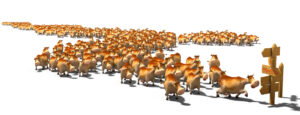
Illustration 20847873 © Vallav | Dreamstime.com
Microsoft tries to create a “demand herd” for the things it invests in, such as Artificial Intelligence. When you’ve got the muscle, why not?
This is the risk in a stock market driven by models. The herd rushes headlong into the box canyon. It’s a big force, and you can see it, public companies, in Passive dominance across the top of your 13F ledgers.
Great case in point, Geode Capital, the quant arm of Fidelity, now generally outstrips and nearly doubles FMR.
Across my EDGE dashboard, our SaaS platform for investors, two of 30 portfolios are driven by Fast Trading, the rest by Passive Investment. That’s a herd of models and machines.
They are collectively about 72% of trading volume. Passive Investment is defined by models that buy characteristics – market cap, growth, value, sector. Fast Trading is the pursuit of price with computers.
Now, the herd is well-informed. Passive Investment is guided by models considering macroeconomics, financial conditions and more. Think about the seas of data informing models at Bridgewater, AQR, Millennium.
Blackrock, the world’s largest money manager, uses a system called Aladdin to manage risk. There are roughly $18 trillion of assets depending on it. The name isn’t from Disney but an acronym for Asset, Liability, Debt and Derivative Investment Network.
Markets surge because the herd that’s using data to modulate exposure to equities and other instruments is a vast demand signal. Nonmaterial increases in, for instance, funds directed at the Russell 2000 can drive that market segment up sharply, leading observers to incorrectly conclude that people are betting on revitalized economic growth.
The Russell 2000 is about 5% of equity assets. Nearly 95% of assets are in the Russell 1000. And there’s no liquidity.
Case in point, I bought and sold EDU in the EDGE Momentum portfolio Friday. It’s got $13.5 billion of market cap, 1.6mm shares of daily volume, trades $6,400 at a time.
But I could barely wriggle in and out of it. My trade was all of the demand and supply at the top of the book. I had to place and cancel multiple orders to get in and out. A trade for 99 shares was more than the average dollar-trade-size ($8,000 vs $6,400 on average).
Public companies, this is a rampant and endemic problem for you. EDU, a Chinese ADR, is among the thousand most liquid stocks in the market. And if I can’t get in or out, how will Blackrock?
Extrapolate that problem over trillions of dollars. This is why markets surge. Or plunge.
Add in ETFs. Big investors can drive up the market with tiny trades, then swap their equity holdings to Blackrock in a tax-free, like-kind exchange for the same value of ETF shares, and dump the ETF shares. Down the market goes.
The big institutions don’t care. They’ve already made their money. The sponsors of ETFs don’t care. The money is in creating ETF shares.
In 2022 through October, over $5.9 trillion of ETF shares had been created and redeemed through this process. In 2022, stocks fell 20%. October was the bottom. Yet ETF shares outstanding increased by $500 billion.
In 2023 so far, over $5.3 trillion have been created and redeemed, data from the Investment Company Institute show, a net $360 billion of issuance, against gross monthly totals of over $500 billion.
Look back. After the big run-up into early August, the market declined roughly ten percent then got it all back in a week. Normal? Reflective of economic conditions? What economic conditions changed in a week?
No, it’s the mechanics I’ve just described.
And no wonder everybody trades ETFs. As I write, there are 516,000 shares at the bid to buy in SPXU, a levered short ETF, and 443,000 at the offer to sell. If you trade it at the market, you’ll pay a tenth of a penny spread.
JNJ by comparison has 200 shares at the bid, 900 at the offer, with a two-penny spread.
That’s the problem. It’s vastly easier to trade SPXU than any actual stock.
Even TSLA, among the four most liquid stocks, has just 200 shares at the bid and offer. NVDA, which trades $20 billion of stock daily in over 600,000 daily trades, has just 100 shares, the regulatory minimum, at the bid and offer.
Who created that problem? The SEC, by subordinating investment to trading.
At some point, these facts will present the market with a serious problem. It’s incorrectly designed for fostering investment. This is why public companies must become a louder voice in Washington, DC.