Very slowly than all at once is how things tend to happen.
It seems to be true in the stock market.
A Demand/Supply view of Micron (MU), darling of the AI trade, is like that. Run a three-year chart at EDGE, and Demand exploded in April 2025 after the Tariff Tantrum.
Than all at once it ended. Demand broke down in May this year and hasn’t gotten its groove back even as the market has smoked like leveraged ETFs in recent days.
It’s so pervasive in semiconductor stocks, this collapse in Demand, that I titled my Aug 3, 2026, daily note for EDGE subscribers: “The end of the beginning.” I heard somebody on CNBC use it yesterday.
It’s what Winston Churchill said after El Alamein, the first decisive WWII win for the Allies. He called it “the end of the beginning.” Very slowly than all at once we won.
In the 1926 novel “The Sun Also Rises,” Ernest Hemingway’s character Mike Campbell describes going broke: gradually, then suddenly. A long series of compounding bad decisions culminate in sudden collapse.
The stock market is a reflection of a long and compounding series of decisions. Once it was an investment market that raised capital for companies. It’s become something else.
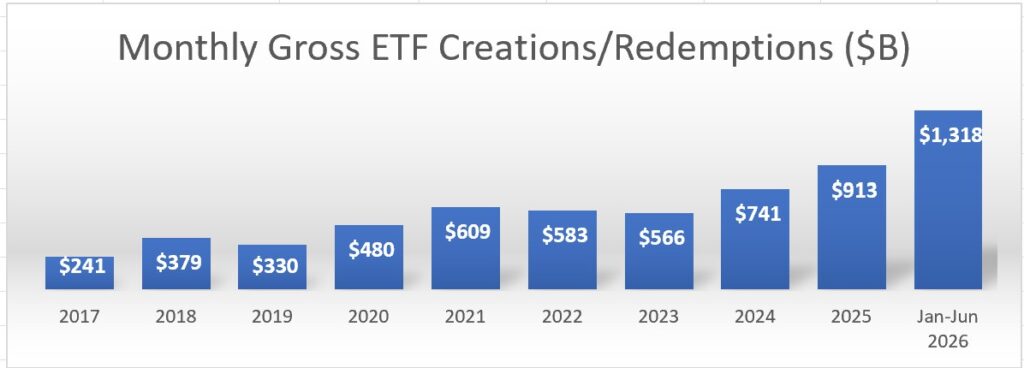
As I’ve written before, the market has 5,000 ETFs with $16 trillion of assets that create and redeem – pump money into and out of the market like a pacemaker – at a rate of $1.3 trillion per month.
In June, it was $2 trillion, far and away the biggest number ever. That’s bellows whooshing onto a flame, sucking in, breathing out.
A hundred big ETFs trade more volume than the 140 largest stocks, which are 75% of market cap. SPY, a proxy for the S&P 500, trades over 50 million shares per day. Ten leveraged ETFs and a bitcoin fund trade more.
The original idea for ETFs came from State Street commodity traders who reasoned that trading warehouse receipts was a lot easier than moving physical commodities.
ETFs were born. Trading stocks is difficult and expensive. Trading ETF shares is easy and inexpensive.
We have often wondered what would happen to stocks in a market dominated by ETFs, which have compounded slowly over time. This image below that we created with Investment Company Institute data show how ETF creations and redemptions have suddenly accelerated.
And now the market has a propensity to plunge and soar. July 30 was the biggest down day of the year for the DJIA – all members of which are also in the S&P 500. Yesterday it rose that much, capping a roaring Jul/Aug transition.
You’d think we were in the middle of a crisis with these extremes. In a sense we are. The United States has intervened in the yen market, curiously. It suggests some belief the yen is in trouble. I’ve long contended the yen would be the first fiat currency to fail.
The South Korean Kospi lost 40% of its value. So did MU from its June 25 peak over $1,213 to the Jul 29 nadir at $739.
But in a matter of days stocks have gone berserk and pundits are crediting awesome fundamentals, massive earnings.
Except the data don’t show that.
The data show the biggest ETF pattern we have ever seen.
To know what drives the stock market, one must understand its mechanics. It’s dominated by ETFs and priced by machines. These are not notions. They are reflections of observable facts. ETFs dwarf all other fund flows combined.
The image here created with ModernIR software from public data and proprietary processes is the biggest ETF pattern in SPY (a substitute for stocks) we’ve ever recorded. It’s the equivalent of a 10.0 earthquake, in the sense that there’s never been one.
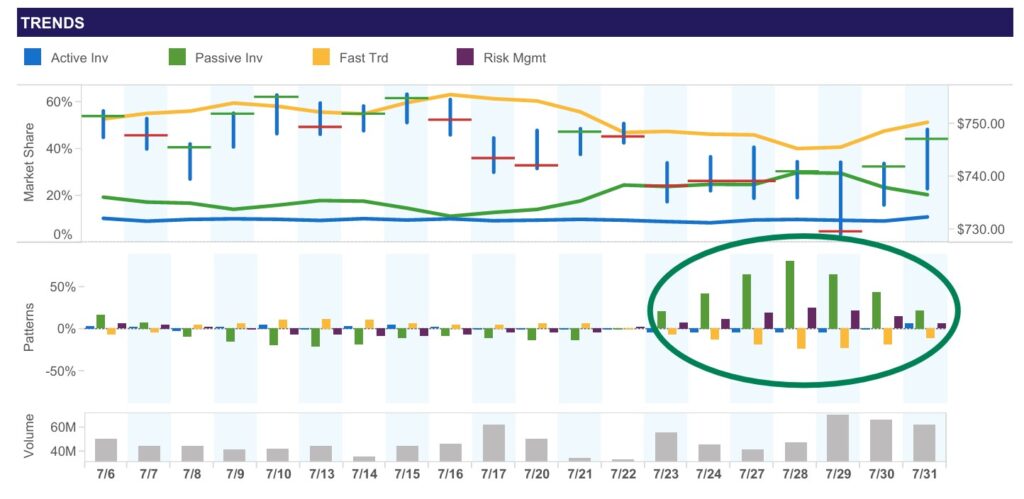
Its mathematical symmetry underpinned both the sudden late-July tumult and the following surge. Bellows, in and out.
The reason it matters is because there is a narrative that doesn’t match flows and patterns. The market is not surging on crazy earnings like the price of tulip bulbs in Holland, on investor enthusiasm.
Giant, mathematical and automated ETF machinery drove it. Very slowly. Then all at once.
Now maybe the machinery just dissolves back into the ocean and the surface stills and everything goes on as it has.
Or maybe not. Whatever happens, it’s apparent we’ve reached a tipping point of sorts, a culmination of extended years of decisions to pack the market with instruments principally dependent on arbitrage. This price versus that price.
Arbitrage causes mean-reversion. Violent mean-reversion is violent arbitrage.
We see patterns everywhere. Public companies, you should know the patterns behind price and volume because they show you the kind of money driving shareholder-value.
And then you’ll know what’s coming, and you can strategize, and measure outcomes. Ask us for help.
Investors, don’t be fooled by ETF arbitrage. We could see the AI trade. Demand surged everywhere. There is literally no Demand surge anyplace in STOCKS. It’s in ETFs.
During the booming AI trade, I highlighted SNDK on CNBC, on The Schwab Network. SNDK is in its weakest Demand cycle since coming public again. The SOXX en toto has Demand of 2.0/10.0.
Now, who knows? We’ve never seen a pattern this large, and it just ended. So we will all find out together what happens when the biggest ever ETF pattern suddenly stops.